
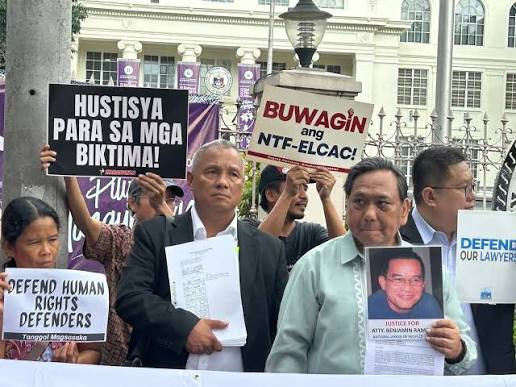
KARAPATAN welcomed the Supreme Court’s issuance of the writs of amparo and habeas data, along with a Temporary Protection Order (TPO), in favor of human rights lawyer Atty. Rey Gorgonio and peasant rights advocates Joselito Macapobre, Analyn Mirano, and Ma. Anabelle Ilustrisimo, saying the Court’s action underscores the serious and imminent threats faced by human rights defenders who are subjected to state-sponsored red-tagging and harassment.
The Supreme Court ordered respondent military and law enforcement officials, including Lieutenant General Antonio G. Nafarrete, not to go within one kilometer of the petitioners and their immediate family members while directing them to answer the allegations before the Court of Appeals.
“The Supreme Court’s issuance of the writs of amparo and habeas data, as well as the Temporary Protection Order, is a significant recognition that the threats confronting Atty. Rey Gorgonio and the human rights advocates of Paghida-et sa Kauswagan Development Group (PDG) warrant immediate judicial protection,” said KARAPATAN secretary general Cristina Palabay.
“The Court’s action validates what human rights advocates have long been asserting, that red-tagging is a dangerous state policy and practice that exposes its targets to surveillance, intimidation, fabricated charges, arbitrary arrests, enforced disappearances, and even extrajudicial killings.”
In their petition, Gorgonio and his co-petitioners alleged that they were falsely labeled by military and law enforcement agencies as members of the Communist Party of the Philippines and the New People’s Army because of their human rights work and development initiatives among farmers and rural communities in Negros Island.
KARAPATAN stressed that the petitioners’ experience mirrors that of many human rights defenders, development workers, lawyers, church people, journalists, and community organizers who have been targeted under the government’s counterinsurgency campaign.
“Negros has long been one of the country’s most dangerous regions for land rights advocates, development workers, and activists. Repeated incidents have shown that red-tagging is often the first step in a chain of violations that can culminate in unlawful arrests, enforced disappearances, or killings. This is precisely why the petitioners sought the Court’s protection,” Palabay said.
“Protective writs exist because the Constitution recognizes that the rights to life, liberty, and security must be defended against abuse. While this development is welcome, the ultimate measure of justice is not merely the issuance of protective orders but the cessation of red-tagging and the accountability of those who perpetrate it.”
KARAPATAN called on the Court of Appeals to expeditiously hear and resolve the petition. It also renewed its call to dismantle policies and agencies that proliferate red-tagging, including the National Task Force to End Local Communist Armed Conflict (NTF ELCAC), which implements the Marcos Jr. administration’s counter-insurgency policy, the National Action Plan for Peace and Development (NAP-UPD).
“The Supreme Court’s action offers hope to Atty. Rey Gorgonio, the PDG development workers, and countless others who face similar threats. But this case should also serve as a reminder that no human rights defender should have to seek extraordinary judicial remedies simply to stay alive and continue serving the people. We continue to call for the abolition of the NTF-ELCAC, its local counterparts, and the junking of the wholesale NAP-UPD that makes the country a dangerous place for human rights defenders,” Palabay ended.