
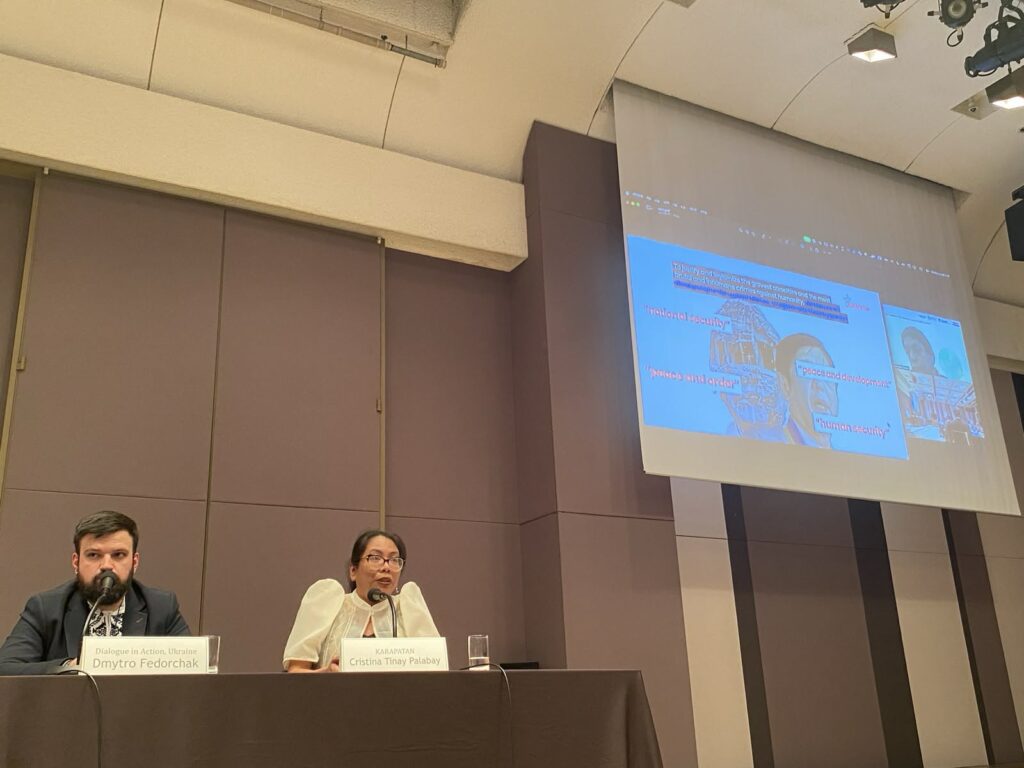
Contribution to the 2026 International Ecumenical Peace Convocation
Seoul, Republic of Korea
09 September 2026
Cristina Palabay
KARAPATAN Secretary General
Good day to everyone, and thank you for having us in the panel.
The Philippines is in a seemingly chronic state of crisis as far as human and people’s rights are concerned. The violations of human rights and international humanitarian law are systematic and systemic, which means that these are deliberate acts, which were planned methodically, instigated and funded by State authorities and actors, and that these are borne out of a system that breeds and maintains injustice, despite the Philippine government’s accession or ratification of almost all international covenants on human rights.
From the Marcos dictatorship in the 1970’s to the current Marcos the son’s administration, government campaigns pertaining to the most-often used bywords of “national security,”
“peace and order,” “peace and development,” “human security,” and others have been used to justify and legitimize the gravest atrocities and the most brutal and inhumane crimes against humanity.
Filipinos are still reeling from the sham drug war of former President Rodrigo Duterte which resulted in the mass murder of more than 30,000 citizens accused of peddling or using drugs, including more than 300 children and minors who were considered “collateral damage.” The killings, conducted in the name of “peace and order,” were done during legitimate police operations or by so-called vigilante or gun-for-hire groups, but the rhetoric of Duterte made it worse – the policy made more forceful and palpable by direct statements of the former president to kill, kill, kill and his guarantees of immunity.
Under Marcos the son, the killings continue with more than a thousand people killed, according to the UP Third World Studies Center Dahas Project. Arbitrary listing of drug users or peddlers continue at the village level, and the police memoranda issued by Duterte were never rescinded, and are thus effectively enforced to this day.
Violations of human rights and international humanitarian remain unabated, Marcos the son continues the counter-insurgency programs of his predecessors.
KARAPATAN has documented 147 individuals killed by the Armed Forces of the Philippines and the Philippine National Police since July 2022, while attempted murder of 87 individuals was also recorded. Majority of the victims were poor peasants, who were publicly portrayed as armed rebels, even if their families and communities attest to the fact that they weren’t combatants.
Among those recently killed were nine civilians, including a journalist, youth organizers, and Filipino-American activists, in Negros Occidental, together with ten hors de combat. The Negros 19 as they are referred to were killed in broad daylight, in a fishpond where they had nowhere to escape to. The incident is the fourth case of massacre in the island of Negros – an island whose vast tracts of productively agricultural lands are owned by the country’s biggest landlords, while generations of peasants have tilled lands which were taken from them and when they take seasonal work, they get paid with slave wages.
Also killed were Kuni Cuba, a 16-year old student from an indigenous tribe, while he was chanced upon by soldiers when they were walking home from a community event; 16-year old Everly Kee Jacolbe who was killed with her mother and a family friend at their home in Negros Oriental; and a 4-year old boy and his 11-year old brother who were killed with their peasant activist parents in their home in Negros Occidental.
None of these killings have been thoroughly investigated by government agencies, and no perpetrator among the State forces have been made accountable.
This pattern is similar to the acts of abduction and enforced disappearances documented by KARAPATAN. Currently, there are 16 victims of enforced disappearances who remain missing to this date. This includes environmental advocates, women’s rights activists, and peace consultants. There were those who were abducted and then surfaced, and they testified that those who captured them and kept them incommunicado from their loved ones and lawyers were the soldiers. None of these enforced disappearances have been thoroughly investigated by government agencies, and no perpetrator among the State forces have been made accountable.
Political prisoners still exist in the Philippines, with their current number at 560, 165 of them were arrested under Marcos the son. All of them face trumped up criminal charges, in an attempt by the State to hide the political nature of their arrest and incarceration. The charges are trumped up because the testimonies against them are fabricated, the evidence were planted, and they were denied of the due process and their right to fair and speedy trial. Many of them are charged with made up counter-terrorism cases, the newest form of legal offensives, against those who exercise their right to political dissent.
All these violations are outcomes of a counter-insurgency program that is patterned, driven and funded through government monies, US military aid and provision of US war materiel such as Blackhawks, Tomahawks and drones – a form of preferential treatment for the Philippines which is considered the US closest ally among South East Asian governments. In return, the Philippine government not only gets to suppress opposition to its anti-people policies and programs – it also gets to be on the good side of the US as it builds military bases, increases the number of troops, utilizes land and other resources in the Philippines for the US geopolitical interests in the Asia Pacific region. The latest plan is the creation of an economic and security corridor in the Philippines, which includes the Pax Silica initiative, to lock in the Philippines’ role in providing free land and cheap labor for the US global military industrial complex.
While the situation remains dire, and the conditions for just and lasting peace are challenging, the Filipino people remain unrelenting in our struggle for genuine peace. We have successfully enabled the arrest and detention of former President Duterte at the International Criminal Court – the first Asian president to be indicted and is now facing trial at the ICC. Campaigns on human rights have steadily continued, with new coalitions and constituencies organized, new human rights defenders capacitated, and mass actions conducted. Our documentation efforts do not only portray the objective conditions – we likewise document our stories of learning, of strengthening and of hope. International solidarity allies, despite being intimidated by the Philippine government, have increased in the last few years, pledging their continued support for the struggle for genuine freedom and democracy in the country.
Churches are crucial allies of human rights defenders in domestic and international spheres. You have been with us during the dark nights, offering support and solidarity that is immeasurable to those who need them most. You lent your voice for us, emphasizing that just and lasting peace is not the peace of the graveyard nor is it merely the silence of guns – it about rights, dignity, equality, self-determination, and freedom. You have been with us during small victories, offering resilient accompaniment. You were and have been one with us – and this is the most important beautiful thing in these difficult times. Our power as peoples, whether from the Philippines, or from Korea, West Asia, Sri Lanka, Colombia, Ukraine or Russia, is the collective power that no State can ever diminish, no tyrant can ever belittle. Let us continue to claim and reclaim this power for a genuinely just and lasting peace.
Thank you very much.