
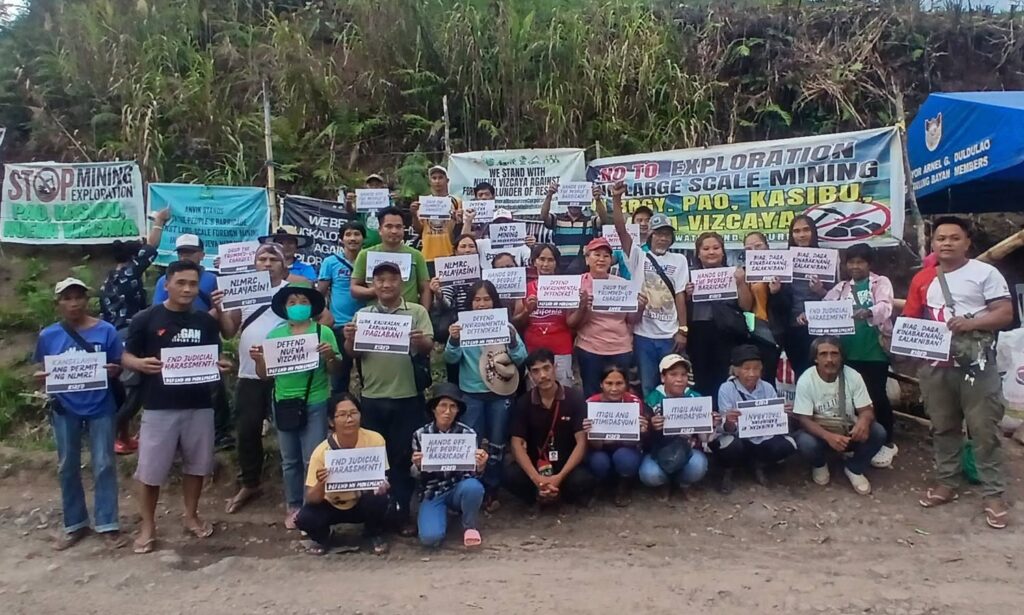
KARAPATAN condemned the arrest of Kasibu municipal councilor Anthony Glenn Guingayan Sr. and the legal harassment of indigenous peoples, farmers, and environmental defenders in Kasibu, Nueva Vizcaya, who have opposed the entry of North Luzon Mineral Resources Corporation (NLMRC) into their ancestral territories.
For months, residents of Kasibu — many of them members of the Kasibu Inter-Tribal Response for Ecological Development (KIRED) — have been maintaining community barricades in Barangays Paquet, Dine and Catawaran against NLMRC’s mining exploration activities. NLMRC obtained a permit in May 2025 for gold and copper exploration covering 4,456 hectares, land which residents say forms part of the ancestral domain of the Bugkalot/Ilongot indigenous communities.
On August 19, 2026, police arrested without warrant three KIRED members — Leijin Dugay, Donny Dugay, and June Fiataccag — during ongoing negotiations with local officials. Around the same period, anti-mining advocate Lei Jin Dugay was charged with cyberlibel by NLMRC representative Jaime Atayde, following criticisms she raised about the company’s environmental impact and its consultation process with the community. Prior to this, their legal counsels Fidel Santos and Edgardo Balgos, were also charged with cyberlibel by NLMRC for representing Kasibu residents. Community leader Florentino Daynos also faced a similar complaint over his support for the barricade. Various rights and environmental groups called on prosecutors to dismiss these complaints, noting that the pattern causes a chilling effect on communities and their legal representatives.
On August 28, 2026, police moved to clear the community’s blockade against fuel trucks intended for NLMRC’s operations, arresting eleven residents — the “Kasibu 11” — from Barangays Paquet, Dine, and Catarawan, on charges of grave coercion and resistance and disobedience. Two other residents were hospitalized during the incident. The eleven posted a combined bail of P401,610 (P36,510 each) and were released on September 2, 2026. Following their release, Bayombong Bishop Jose Elmer Mangalinao called for dialogue between the mining firm and residents. Bishop Mangalinao and local parish priest Fr. Christian Dumangeng also faced charges in connection with their opposition to the project.
The legal harassment has continued since. On September 24, 2026, the Municipal Trial Court of Kasibu and the Regional Trial Court of Bayombong issued separate arrest warrants against indigenous anti-mining leader Donny Dugay and Barangay Pao Councilor Anthony Glenn Guingayan Sr., for grave coercion and cyberlibel, respectively. These warrants followed the filing of three counts of grave coercion against eight environmental defenders from Barangay Kakiduguen. Guingayan was arrested the same day on seven counts of cybercrime under Republic Act 10175 (Cybercrime Prevention Act), with bail set at P252,000.
Karapatan deputy secretary general Atty. Maria Sol Taule said these moves are designed to criminalize anti-mining activists. The recurrence of cyberlibel and cybercrime charges against those who speak publicly against NLMRC’s operations, combined with bail amounts disproportionate to the resources typically available to community advocates and local officials, said Taule, shows that these legal actions are meant to prevent individuals from campaigning against NLMRC rather than address genuine grievances.
Lawyers representing the affected residents have described these cases as Strategic Lawsuits Against Public Participation (SLAPP). “Such cases are utilized by powerful entities to suppress free speech and public criticism. They are designed to intimidate or silence critics by harassing and burdening them with legal costs,” stressed Taule.
“The drive to extract mineral resources has intensified after the Marcos Jr. regime fast-tracked the granting of foreign mining permits on some 9 million hectares of mineralized land through Executive Order 122,” she added, “as part of the US’ Pax Silica initiative that the current regime joined in April 2026.”
Taule warned that with the stakes this high, corporate and state measures against protesting Kasibu residents may escalate from the filing of trumped-up charges to more serious human rights violations like actual physical violence, torture, extrajudicial killings and enforced disappearances.
Environmental activists have long been under threat in the Philippines, with the country being cited as the most dangerous in Asia for land and environmental defenders for 13 consecutive years. Twelve killings of environmental defenders were documented by Global Witness in 2025 in the Philippines—the highest number recorded outside Latin America—with six victims belonging to indigenous peoples. Mining was identified as the deadliest sector globally, and four of the 11 mining-related killings worldwide occurred in the Philippines.
“KARAPATAN expresses solidarity with the people of Nueva Vizcaya in their continuing battle to defend their land against encroaching mining interests,” said Taule. “We will continue to closely monitor developments on the ground and vow to stand with the Novo Vizcayanos in this fight.”