
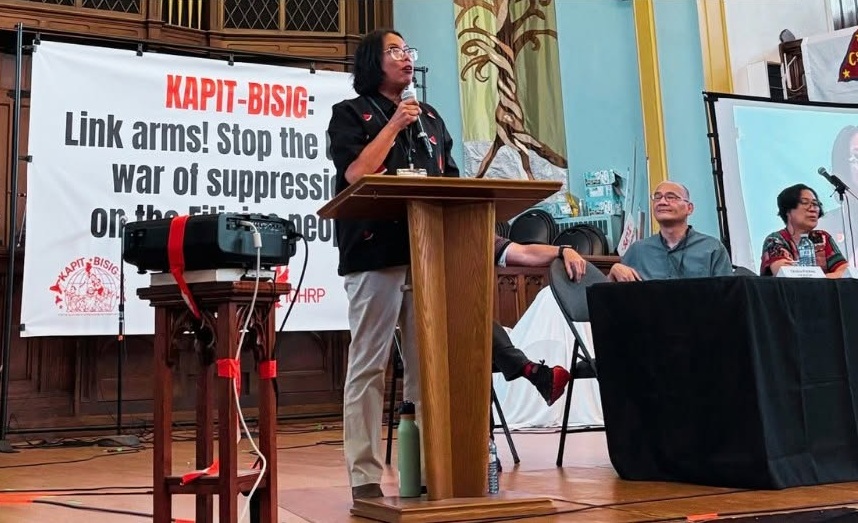
Cristina Palabay, KARAPATAN Secretary General
Kapit Bisig Conference
Toronto, Canada
25 – 26 September 2026
Magandang araw sa ating lahat. On behalf of KARAPATAN’s fighting chapters, organizations and individual members, I am overjoyed to join you today in the Kapit Bisig Conference, with the privilege of being in the first conference organized by ICHRP in 2013 in Manila.
I will speak today on the aspect of people’s rights on which ICHRP started its solidarity work that is on the suppression of dissent in the Philippines. The suppression of dissent in its most brutal forms to its most insidious means has been intrinsically linked to the history of colonialism, neocolonialism and political resistance of the Filipino people’s movement for national and social liberation. Our colonial past informs our neocolonial present.
The Spanish government built its empire around “the inseparable union of the Church and the state” which shaped the policies of the colonial administration. Sedulas, decretos, resoluciones were used to suppress resistance to colonial rule and instill a social order in accordance to the interests of Spain. The formal prison system in the Philippines started during the Spanish colonial rule. Among the notable cases of those imprisoned due to their roles in political resistance include the three Filipino priests collectively known as Gomburza (Jose Burgos, Jacinto Zamora, and Mariano Gomez), who were detained following the 1872 mutiny and publicly executed via garrote; Jose Rizal, who was detained at Fort Santiago before his execution; and worker revolutionary Andres Bonifacio, who was tried, detained and executed in Cavite.
As the American colonial rule came, the US conducted massacres and used the legal architecture of legislation to suppress resistance and criminalize advocacy for independence, reclassifying anti-colonial fighters as common criminals. As nominal independence was declared by the United States in 1946, laws of the neocolonial government defined laws on rebellion, insurrection, and sedition and used them against dissidents who opposed the US continuing dominance on Philippine politics and the puppet elite rule.
The regime of Ferdinand Marcos the dictator-father paved the way for the imposition of martial law and the use of US-driven counterinsurgency programs, which resulted in thousands of killings, torture, disappearances and illegal or arbitrary arrests.
The regimes that followed up to Ferdinand Marcos the son saw the intensified suppression of dissent, through the use of white terror through extrajudicial killings, abductions and enforced disappearances, torture, bombings and hamletting, arbitrary arrests, criminalization of political offenses, and prolonged detention, as counterinsurgency programs were framed in the US “war on terror” campaign and the subsequent adoption of the “whole of government,” “whole of society,” and “whole of nation” approaches to counterinsurgency.
Red- or terrorist-tagging by government officials and agencies are conducted to mark targets of “neutralization.” Such resulted in more than 2,000 extrajudicial killings of civilians, nearly 300 victims of enforced disappearances, hundreds of victims of torture and more than 1,300 political prisoners. The climate of impunity worsened, normalizing killings, staged crime scenes, planting of evidence, and other various forms of violations of the right to due process.
Marcos Jr.’s National Action Plan on Unity, Peace and Development (NAP-UPD) which is being implemented by the National Task Force to End Local Communist Armed Conflict, maintains and implements a “whole of nation” approach, utilizing the civilian bureaucracy and employing psywar tactics to bury the grave violations of human rights and international humanitarian law.
This approach was most apparent in the case of Negros 19. Based on fact-finding efforts, the massacre of the Negros 19 is a blatant example of the regime’s take-no-prisoner policy or no quarters given – a most grave violation of IHL, which even under Philippine laws, is a considered a crime. It is the single biggest casualty incident of an IHL violation that we have addressed in the last two to three decades. In less than 24 hours after the incident, the AFP announced with glee that it had successfully killed 19 terrorists. The arrogant defense secretary said they deserved that because they are terrorists. An organization of military agents, posing as an NGO conducted a factfinding mission contaminating the crime scene. Local government officials and congressmen approached the House of Representatives to stop investigation efforts. The Negrense landlords and capitalist educators banded together to campaign against the students’ right to organize and freedom to exercise critical thinking. The mad trolls of the NTF-ELCAC swarmed social media calling the 19 with derogatory names.
This approach is likewise most visible in the use of laws and the Philippine justice system for political repression, with the enactment of laws such as the Anti-Terrorism Law and the Terrorism Financing Prevention and Suppression Law and the massive use of criminal charges against activists and revolutionaries. Government bodies were created to either systematize the filing of trumped up charges against activists and revolutionaries and put them in jail, or to justify their killings, disappearances, arrests and torture. To date, more than 200 had been charged using the terror laws, with more 80 arrested and detained based on these charges.
Almost all 560 political prisoners at present faced criminal, not political, charges ranging from murder, attempted or frustrated murder, arson, robbery, kidnapping, and illegal possession of firearms and explosives, coupled with facing counter terrorism charges. More than half face the trumped up charges of illegal possession of firearms and explosives, probably due to the ease by which these charges are concocted through planting of evidence and the presumption of regularity protocol in the military or police operations during arrests and the non-bailable provisions regarding these charges.
While in jail, the extremely slow-paced justice system enables prolonged detention even of those who are still in the process of being tried in court. There is no regularity of court hearings, prosecution witnesses are given wide latitude in being remiss or postponements in giving their testimonies in court, and perjured testimonies as well as planted evidence are admitted as evidence. It is estimated that a political prisoner is kept in prison for an average of 5 to 6 years, before most of the charges against them are dismissed or they are acquitted of these charges.
Meantime, they are subjected to prison conditions in one of the most overly congested jails in the world, with an average of more than 500% over-congestion prison rate in the last five to ten years. Political prisoners are mixed with common offenders in cramped detention cells, where many sleep on bare floors or would have to pay a hefty fee for a decent bed. Food is rationed, with government allotting ₱100.00 (or USD 1.60) per day as budget and few more pesos minus that amount lost in the web of jail corruption. Thus, prisoners, including political prisoners, are left with food that is unhealthy, at times rotten, and barely digestible, while access to drinking water and water for hygiene and sanitation is very minimal. Prison conditions likewise aggravate the medical conditions of the elderly and those with illnesses, including debilitating ones. With a very measly ₱15 (USD .25) per day medicine budget, without regular doctors and nurses in jails, without health including reproductive and mental health facilities and services in jail, many political prisoners have considered these prisons as the “cemetery for the living.”
Administrative policies in relation to accreditation and registration of non-profit or non-governmental organizations have been hewed in accordance to the laws on terrorism, which meant a more restrictive environment for and increased state intrusion on the operations of NPOs and NGOs, as well as more stringent processes on funding. International solidarity allies, some of them have been based in the Philippines for years, have faced deportation proceedings and blacklisting of the immigration office.
In all these and more, the intent of the reactionary regimes is clear – to destroy the revolutionary movement and to quell political dissent of the citizens. The weaponization of the law and the use of extrajudicial killings, enforced disappearances, torture and other grave violations are the tools of the reactionary regimes.
But State violence, through the most brutal to the most insidious means, has never succeeded in silencing or quelling the people’s resistance.
Through the years, the legal and democratic mass movement in the Philippines have utilized legal and campaign tactics and forms to counter such machinations. Court battles to question the legal bases of the arbitrary or illegal arrests and detention and legislative proposals of progressives in parliament are coupled with mass campaigns to frustrate or blunt attempts to impose more draconian measures.
Political prisoners defy prison walls and iron bars as they fight for freedom from the small prisons where they are confined to the bigger prison that is Philippine society, as they wage prison struggles, campaigns for their release and campaigns in support of the people’s movement. Political prisoners led by community journalist Frenchie Mae Cumpio and KARAPATAN’s Glendhyl Malabanan lead 3,000 prisoners in exposing the corrupt practices in jail and release statements of support for the peasants’ struggle for genuine agrarian reform. Political prisoners led by peace consultants Eduardo Sarmiento and Leopoldo Caloza organize rallies inside prison against the mass transfers of prisoners to far-away provinces away from their support system and release statements supporting the campaign against the US wars of aggression. Political prisoners including Fr. Frank Fernandez and LGBTQIA activist Verdi Pongasi led prisoners’ actions for several months against abuses by jail officials and called for the release of all political prisoners.
Two brave young women Jhed Tamano and Jonila Castro outwitted the dirty old men of the NTF-ELCAC in their own press conference, as they spoke of their abduction, contrary to the NTF-ELCAC’s line that they surrendered, and fought their way to freedom. Filipino-American activist Christina Pasion, asserted to call her lawyers to expose the indignities she and her companion suffered during their arrest, and while in detention, she slipped a note with P50 saying she is sharing this money with other political prisoners. Castro, Tamano and Pasion, along with many others, embody the sheer courage and strength of the Filipino people, who stared at the enemies in the eye and told them – we will not be afraid because ours a just struggle.
At the core of these mass campaigns are the human rights defenders, the victims of human rights violations, the families of the victims of EJKs, of desaparecidos, of political prisoners, of former political prisoners, who each day fight for justice together with the people’s movement. We have also launched the Justice for Negros 19 movement, the LAYA Campaign for the Release of All Political Prisoners, the Manindigan campaign against violations of human rights and international humanitarian law in the countryside, and the Duterte Panagutin movement, which are broad campaign networks that we invite you to support.
I’d like to end with this call by peace consultant Alan Jazmines, a former political prisoner, which he wrote when he was still in prison: “In the meantime, that fascist and anti-peace authorities are keeping us, we are determined to fight in prison. This smaller prison that is but a part of the bigger prison that is the entirety of the failed and defunct, exploitative and oppressive political and socio-economic system in the country, that…the Filipino people are determined and struggling to change. The smaller prison we are presently confined in, after all, is a means of getting rid of those who cannot be tolerated by the fascist forces but are still kept alive in the bigger prison of the present system. The fight in the smaller prison goes in tandem with the fight in the bigger prison.”
Makibaka, wag matakot!
Long live international solidarity!