
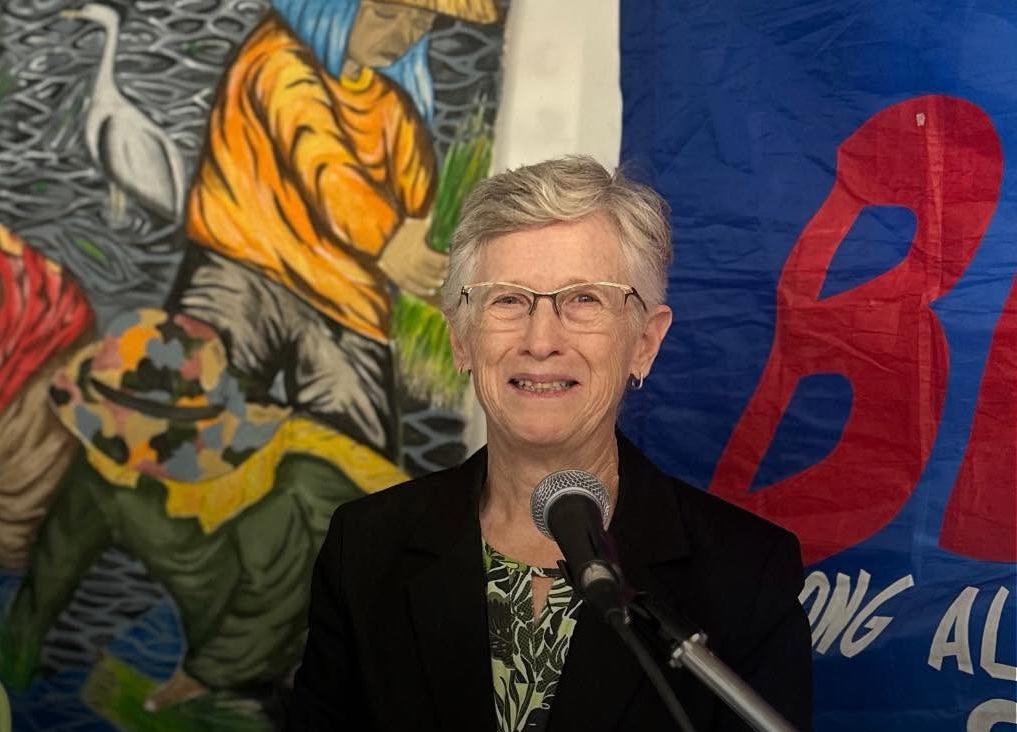
Solidarity: From Listening to Accompaniment
Speech of Rev. Dr. Patricia Lisson, Vice Chairperson of the International Coalition for Human Rights in the Philippines
Dear friends,
More than thirteen thousand kilometres separate Manila and Toronto. On a map, the Philippines can seem very far from Canada.
But solidarity creates a different geography.
It brings distant communities into relationship. It allows the suffering of people on one side of the world to disturb the conscience of churches on the other. It reminds us that distance does not release us from responsibility.
My understanding of solidarity has taken shape within The United Church of Canada and has deepened through relationships with ICHRP Canada, Philippine church partners, and the Global Ecumenical Forum for Just Peace in the Philippines and spending time in the Philippines. At its heart is a theology of accompaniment: the belief that God calls us to walk alongside one another, to listen and learn across differences, and to share in the struggle for a just and lasting peace.
Families and communities have entrusted us with stories of suffering and resistance. What has affected me most is not simply the violations documented, but the trust involved when people place their stories in our hands. Once someone entrusts us with such truth, we must decide whether we will carry it into action or leave them carrying it alone.
For me, this is where solidarity begins: not with speaking, but with listening.
My central conviction today is this: international solidarity becomes faithful when listening leads to relationship, relationship leads to responsibility, and responsibility leads to action.
It is significant that we are gathered here in Canada. Canada has been a place of refuge, accompaniment, and courageous church witness. But Canada is not neutral. Canadian political, economic, military, and corporate interests have also affected the Filipino people.
We enter this history, therefore, not as outside observers, but as people already implicated in it.
A decisive chapter in the modern history of international faith-based solidarity with the Philippines began during the dictatorship of Ferdinand Marcos Sr. After martial law was declared in 1972, thousands were imprisoned, tortured, disappeared, or killed.
Philippine churches documented these abuses, sheltered people in danger, and carried their testimony to the world. Filipino church leaders travelled internationally, not to ask for charity, but to call churches to act and to examine how their own governments were sustaining the dictatorship.
In 1981, Filipino church workers, international church leaders, and human-rights advocates gathered at Stony Point, New York, for an International Conference on Human Rights in the Philippines. Stony Point helped transform scattered expressions of concern into an organized ecumenical movement.
It also established a model that remains essential today: Filipinos would describe their own reality and determine their own priorities; international partners would amplify their voices and act within their own churches and countries.
Canadian churches became part of that movement. Through the Canada–Asia Working Group, they circulated information, welcomed Filipino human-rights defenders, and brought their testimony before congregations, the Canadian government, and the United Nations. Yet much of the movement’s leadership came from Filipino church workers, migrants, and political exiles. Canadian churches were most faithful when they opened doors and enabled Filipinos to speak for themselves.
This is the tradition of solidarity that I have inherited. It is also a tradition that demands self-examination.
After the dictatorship fell, Canadian churches began asking not only, “What is happening in the Philippines?” but also, “How is Canada involved?”
The destructive operations of Marcopper on Marinduque, and the involvement of Canadian mining company Placer Dome, made that question unavoidable. Land, water, and livelihoods were devastated. Solidarity could no longer mean criticizing injustice somewhere else. It required us to confront the actions of our own government, corporations, and financial institutions.
This history is the soil from which the Global Ecumenical Forum for Just Peace in the Philippines has grown. Its more immediate development can be understood through four stages: truth, relationship, planting, and growth.
The first stage was truth: Investigate PH.
During the Duterte administration, as extrajudicial killings, arbitrary arrests, enforced disappearances, and red-tagging intensified, an independent United Nations investigation did not materialize. Churches, civil-society organizations, lawyers, and international advocates therefore organized their own investigation.
Investigate PH received testimony from victims, families, church workers, and affected communities. It documented both individual violations and the structures that allowed them to continue, bringing its findings before the international community.
Its most enduring contribution, however, may have been relational. By listening together to victims and threatened communities, international partners recognized that the Philippines needed more than occasional statements of concern. It needed sustained accompaniment.
Truth created responsibility, and investigation became relationship.
The second stage was relationship: the International Ecumenical Network for Peace in the Philippines.
The Network connected Philippine partners with church leaders and peace advocates around the world. It affirmed that human rights and peace are inseparable: there can be no authentic peace while people are killed, imprisoned, or displaced for defending their communities.
This was a vital development. Documentation was becoming accompaniment. People were no longer gathering only to respond to the latest violation. They were asking how the international church could remain present for the longer journey toward peace.
The third stage was planting: the Pagtatanim Interfaith Conference.
On June 27 and 28, 2025, more than seventy faith leaders, human-rights defenders, and solidarity partners from thirteen countries gathered in Rome.
Pagtatanim means planting. It was the right image.
Planting is an act of faith: preparing the soil, protecting what has been entrusted to us, and believing that life is already taking shape before it can be seen.
The gathering remembered Stony Point but asked what international faith solidarity must become today. Participants heard testimony about repression, attacks on Indigenous peoples, ecological destruction, and expanding foreign military power. They affirmed the need for principled peace negotiations and made shared commitments to advocacy and accompaniment.
Relationships had become commitments. The seeds had been planted. The question was how they would be cultivated.
The fourth stage is growth: the Global Ecumenical Forum for Just Peace in the Philippines—GEF-PH.
Led by Philippine churches and ecumenical partners, the Forum connects Christian communions, mission movements, theologians, advocates, and grassroots organizations. It strengthens existing work by deepening theological reflection, supporting advocacy, and mobilizing accompaniment for communities under threat.
At the centre of the Forum is a demanding understanding of peace.
Peace cannot simply mean that the weapons have fallen silent. Silence can conceal repression. Order can preserve injustice. Stability can protect the powerful while communities continue to suffer.
Just peace must address the roots of conflict: poverty, landlessness, inequality, ecological destruction, foreign domination, and the denial of human dignity and sovereignty.
In conversation with faith-based peace movements in Korea, Taiwan, Palestine, and elsewhere, the Forum is asking questions shared by churches living amid conflict and militarization. These histories are distinct and must not be treated as interchangeable. Yet they compel us to ask:
Who defines peace?
Whose security is being protected?
Who pays the price of militarization?
And how can churches resist becoming chaplains to empire?
GEF-PH also belongs within the World Council of Churches’ Pilgrimage of Justice, Reconciliation and Unity. It brings a distinct Philippine witness to that global pilgrimage: there can be no reconciliation without truth, no unity that silences the oppressed, and no lasting peace without justice.
The journey can therefore be described simply:
Stony Point organized international church resistance.
Churches carried that witness into public life and learned to examine their own complicity.
Investigate PH documented the truth.
The International Ecumenical Network built relationships of accompaniment.
Pagtatanim planted shared commitments.
And GEF-PH is cultivating those commitments into action.
For me, solidarity has become a promise: to listen truthfully, to remain when public attention moves elsewhere, and to act where I have responsibility.
For those of us in Faith Communities this means examining our churches, our government, our investments, our corporations, and our military relationships. It means opening doors but also surrendering control. It means respecting the leadership of Filipino communities and allowing their witness to deepen our understanding of peace.
Solidarity is not charity offered by the powerful to the powerless. It is the recognition that our lives, our freedoms, and our futures are bound together.
The seeds have been entrusted to us.
The question is not whether they contain life, but whether our solidarity will provide the soil in which that life can grow.
May we have the patience to cultivate what has been planted, the courage to confront the forces that perpetuate violence and injustice, and the faithfulness to remain beside the Filipino people until justice takes root and peace begins to flourish.