
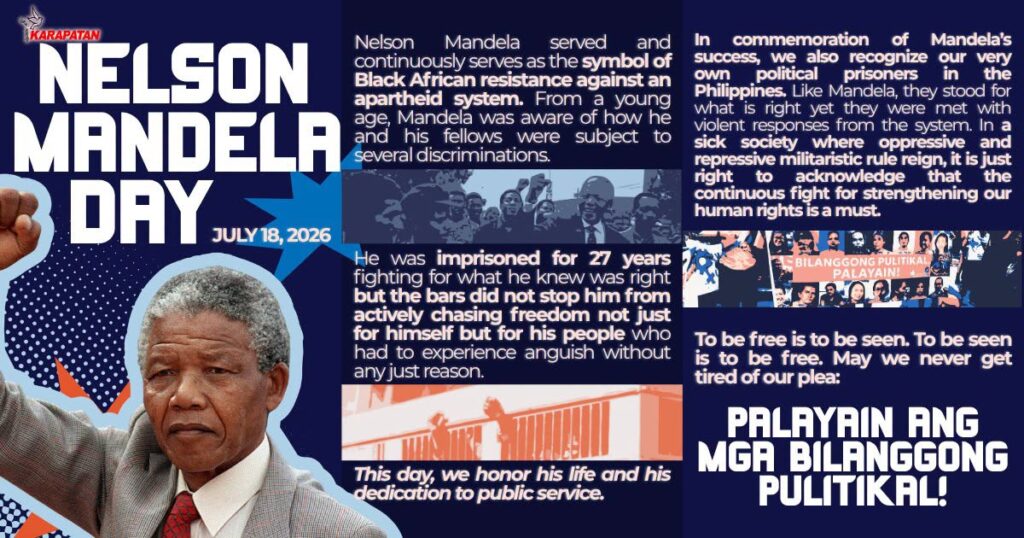
Today, July 18, marks the day of our celebration of Nelson Mandela’s life and his contributions to genuine democracy and social justice. He served and continuously serves as the symbol of Black African resistance against an apartheid system. From a young age, Mandela was aware of how he and his fellows were subject to several discriminations. He was imprisoned for 27 years fighting for what he knew was right but the bars did not stop him from actively chasing freedom not just for himself but for his people who had to experience anguish without any just reason. He was elected as the very first Black African President prioritizing national programs that aimed to expand access to social services, education, and housing. This day, we honor his life and his dedication to public service.
In commemoration of Mandela’s success, we also recognize our very own political prisoners. Political prisoners, by definition, are people detained for political reasons and not because they committed serious heinous crimes. Like Mandela, they stood for what is right yet they were met with violent responses from the system. Political prisoners represent different sectors in society. They are farmers, workers, fisherfold, indigenous and Moro peoples, women, youth, activists, human rights defenders, leaders and members of organizations that promote the rights of the oppressed classes in society. Some of them are suspected members of the Communist Party of the Philippines-New People’s Army-National Democratic Front of the Philippines (NDFP).
In a sick society where oppressive and repressive militaristic rule reign, it is just right to acknowledge that the continuous fight for strengthening our human rights is a must.
Thus, honoring Nelson Mandela’s life and contributions now comes with strengthening our calls to free political prisoners. Up to this day, people who are expressing themselves for being deprived of their rights are thrown into prison subject to inhumane conditions instead of genuinely being heard. The jails are not only jam-packed, they are suffocating for not having enough ventilations, not having enough food and water supply, and are surrounded with abusive police officers. The rights of political prisoners are abruptly diminishing when all they did was to express dissent as they fight for what has to be fixed. The weight they face seems to be the same for someone who committed a serious human right violation. The suffering becomes endless.
May we all live by Mandela’s words saying that to be free is not merely to cast off one’s chains, but to live in a way that respects and enhances the freedom of others. A society where sickness of the system prevails shall come with deviance from the masses who genuinely want their lives better. Their voices are to be acknowledged and addressed and not be further silenced. To be free is to be seen. To be seen is to be free. May we never get tired of our plea : PALAYAIN ANG MGA BILANGGONG PULITIKAL.