
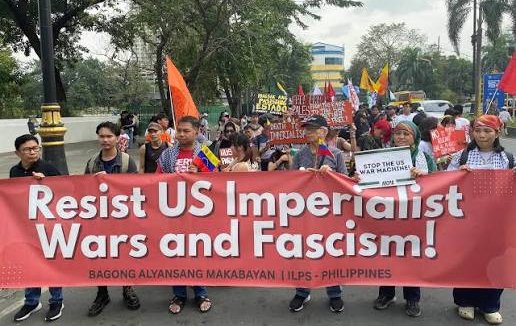
KARAPATAN denounced the Trump administration’s declaration of a global offensive against what it calls “Radical Left terrorism,” warning that this campaign threatens to further legitimize the weaponization of counter-terrorism laws and violations of human rights and international humanitarian law against anti-imperialist and anti-fascist activists, human rights defenders, civil society organizations, and people’s movements worldwide, including the Philippines.
The Trump administration announced the global campaign last week in Washington, where US Secretary of State Marco Rubio convened government representatives from more than 60 countries for the so-called “Ministerial on the Resurgence of Political Terrorism.” Rubio is set to arrive in the Philippines today, July 20, to participate in several meetings in relation to ASEAN until July 23. In the sidelines of the ASEAN events, Rubio is also scheduled to meet Philippine president Ferdinand Marcos Jr.
“The Philippine experience demonstrates the grave dangers of adopting the United States’ counterterrorism and counterinsurgency doctrine,” said Cristina Palabay, KARAPATAN Secretary General. “For years, successive Philippine governments have followed this framework through security agreements, military cooperation, and legislation such as the Anti-Terrorism Act of 2020 and the Terrorism Financing Prevention and Suppression Act. These measures have been used to red-tag, surveil, arbitrarily arrest, detain, and prosecute activists, trade unionists, peasant and indigenous leaders, humanitarian workers, journalists, lawyers, church people, and human rights defenders because of their people’s rights advocacies and dissent.”
Palabay said the Trump administration’s announcement reinforces the same counterterrorism doctrine that the Philippine government has adopted and institutionalized through its counterinsurgency program, now deceptively repackaged under the Marcos Jr. government as the National Action Plan for Unity, Peace and Development (NAP-UPD).
“This doctrine has consistently been used to suppress dissent and silence opposition. In the Philippines, branding legal democratic organizations and individuals as terrorists has become a convenient pretext for violating civil liberties and fundamental political rights. Tagging revolutionary movements as terrorist organizations has become a justification for the commission of war crimes and other forms of violations of IHL, including killings of civilians and hors de combat, bombings and military encampment and combat operations in communities, threats, harassment and other deceptive schemes that undermine civilian authority,” Palabay said.
KARAPATAN likewise expressed grave concern over the Trump administration’s announcement that it would intensify scrutiny of charitable and nonprofit organizations for alleged links to terrorism financing.
“The Marcos Jr. regime has already demonstrated how financial regulations and anti-money laundering mechanisms can be weaponized against human rights organizations, humanitarian institutions, development organizations, people’s organizations, and independent media,” Palabay said. “Asset freezes, bank account restrictions, baseless terrorism financing complaints, burdensome regulatory actions, and financial investigations have been used to disrupt legitimate human rights work, humanitarian services, and development programs. These measures often proceed despite the absence of credible evidence and impose severe consequences even before any judicial determination.”
KARAPATAN further warned that the Trump administration’s call for greater international cooperation against so-called “Radical Left terrorism” could further worsen the already dire human rights situation in the Philippines, particularly given the country’s close military and security relationship with the United States and the expanding U.S. military presence through troop deployments, access to military facilities, and joint military operations.
“What is especially alarming is the push to establish international systems for intelligence sharing, financial surveillance, and coordinated action against organizations and individuals based on broad labels,” Palabay said. “The Philippine government has practiced red-tagging to portray activists, human rights defenders, and even ordinary civilians as terrorists or terrorist supporters. These baseless accusations have been used to justify surveillance, judicial harassment, arbitrary arrests, detention, enforced disappearances, torture, and even extrajudicial killings.”
“If this doctrine is further entrenched through U.S.-led international cooperation, it risks institutionalizing red-tagging and repression across borders. Filipino diaspora organizations, international solidarity networks, humanitarian organizations, academic institutions, trade unions, faith-based organizations, and human rights groups could increasingly face cross-border surveillance, financial restrictions, travel limitations, among others, because of their work and support for people’s struggles for genuine peace, justice, human rights, and national self-determination.”
“The danger extends beyond the United States or the Philippines. What is being advanced is a global counterterrorism architecture that conflates legitimate dissent with terrorism and transforms international cooperation into a mechanism for suppressing democratic movements. Such a framework would embolden governments that already weaponize anti-terror laws against their own people and weaken international solidarity among those defending human rights.”
KARAPATAN stressed that the fundamental rights of the people to freedom of expression, association, peaceful assembly, political participation, or the legitimate work of human rights defenders, should be safeguarded at a time of such attacks and worsening threats.
“We must reject attempts of full-scale repression and attacks against the people. We call on people’s organizations and movements, civil society groups, and human rights defenders around the world to oppose the further export of this repressive doctrine and uphold international human rights standards, democratic freedoms, and the people’s right to organize, protest, and struggle for genuine social change,” Palabay concluded.